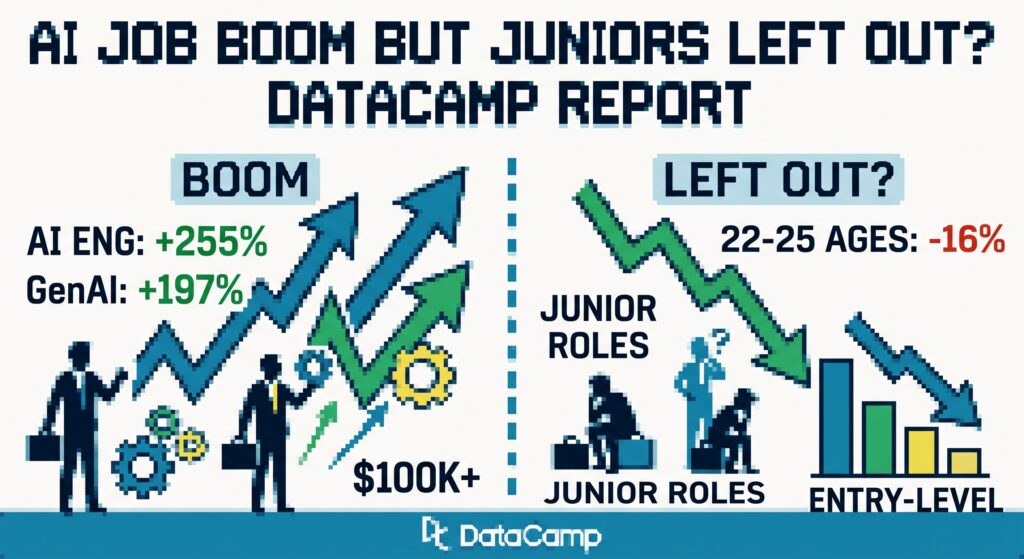
NEW YORK — The global job market for artificial intelligence and data roles is experiencing a sharp rebound after years of stagnation, driven by skyrocketing demand for specialized engineering talent. However, this tech boom is creating a stark generational divide, with entry-level workers bearing the brunt of workplace automation.
According to The State of AI Careers 2026, a comprehensive report released Tuesday by learning platform DataCamp, global job postings for AI and data roles grew 80% over the last year. Analyzing two million unique job listings across 85 regions between January 2024 and April 2026 via labor intelligence firm Lightcast, the study highlights how corporate priorities are rapidly shifting toward advanced AI infrastructure—at the direct expense of early-career positions.
Technical Boom Driven by AI & Generative Engineering
Following a slight contraction in 2024 and flat growth throughout 2025, hiring demand for specialized tech roles has surged. Specialized AI developers lead the charge, commanding six-figure base salaries globally:
- AI Engineering Roles: Grew 255% year-over-year (Median base salary: >$100,000)
- Generative AI Engineering Roles: Up 197% year-over-year (Median base salary: >$100,000)
- Data Science Managers: Earned the highest median base compensation in the analysis, approaching $190,000.
Infrastructure-heavy positions—such as data engineers, Python developers, data architects, and machine learning engineers—also saw robust growth. By contrast, traditional analysis roles, including standard data analysts, general data scientists, and business intelligence specialists, saw slower growth rates under 50%.
+-------------------------------------------------------------------------+
|                  AI & DATA JOB MARKET REBOUND (2024-2026)                |
+-------------------------------------------------------------------------+
|  ROLE CATEGORY                           YEAR-OVER-YEAR GROWTH RATE     |
+-------------------------------------------------------------------------+
|  AI Engineers                            [====================] 255%    |
|  Generative AI Engineers                 [===============>    ] 197%    |
|  Traditional Data/BI Analysts            [====>               ] <50%    |
+-------------------------------------------------------------------------+
The Early-Career Paradox: A 16% Employment Decline
While the total number of tech jobs is expanding, the barrier to entry has heightened significantly. Automated tools are increasingly taking over routine entry-level responsibilities—such as basic code writing, initial data cleaning, and preliminary reporting—reducing the demand for junior staff.
Between late 2022 and September 2025, employment among workers aged 22 to 25 in AI-exposed fields (such as customer support, accounting, and basic analysis) dropped 6%. Over the same period, demand for experienced professionals in those identical fields grew by 6% to 9%, resulting in a 16% relative employment decline for entry-level workers.
DataCamp’s report notes that AI is not causing widespread systemic unemployment across the board; rather, it is actively reorganizing the labor market. Employers are reallocating headcount away from junior training roles toward mid- and senior-level staff who can oversee AI agents and manage complex technical systems.
“AI is changing what it means to be technical and what roles are in demand, and it’s hitting younger workers hard,” said Jonathan Cornelissen, co-founder and CEO of DataCamp. “There’s no one narrative here, but understanding and preparing for this shift is how we put ourselves in the best place to succeed.”
The Rise of “Soft + Technical” Hybrid Skill Sets
As mechanical and procedural tasks become automated, employers are redefining what makes a candidate qualified. Technical execution alone is no longer enough; companies are prioritizing professionals who can contextualize findings and drive business strategy.
In DataCamp’s evaluation across 25 distinct AI and data career paths:
- Communication emerged as a universal, mandatory requirement across 100% of tracked roles, ranking alongside core programming fundamentals like Python, SQL, and Computer Science.
- AI Core Competencies appeared as a fundamental job requirement in 22 out of the 25 roles analyzed (88%).
Rather than purely evaluating coding syntax, modern hiring processes increasingly reward candidates who combine foundational computer science with AI operational skills—such as prompt engineering, AI agent management, and domain-specific implementation.
Market Outlook
The findings align closely with global workforce projections, including the World Economic Forum’s forecast that AI and automation will create 170 million new roles globally while displacing 92 million, yielding a net gain of 78 million jobs by 2030.
However, DataCamp’s report underscores an urgent challenge for higher education and corporate development: as the “first step” on the traditional career ladder disappears, organizations will need to rethink how early-career talent gains the foundational experience required to eventually become senior AI engineers and managers.