Elena Vance, Head of People Culture at climate-tech firm Aether Dynamics, stared at her recruitment dashboard: 14,000 applications received for 12 open engineering roles in under 48 hours.
Six months earlier, executive leadership had introduced TalentPulse AI—an automated recruitment suite featuring automated resume screening, async AI video assessments, synthetic skill scoring, and automated candidate rejections. On paper, efficiency soared. Time-to-fill was cut in half.
Under the surface, however, candidate satisfaction scores plummeted. Hiring managers complained that shortlists felt strangely homogenized, lacking the creative problem-solvers the firm was known for.
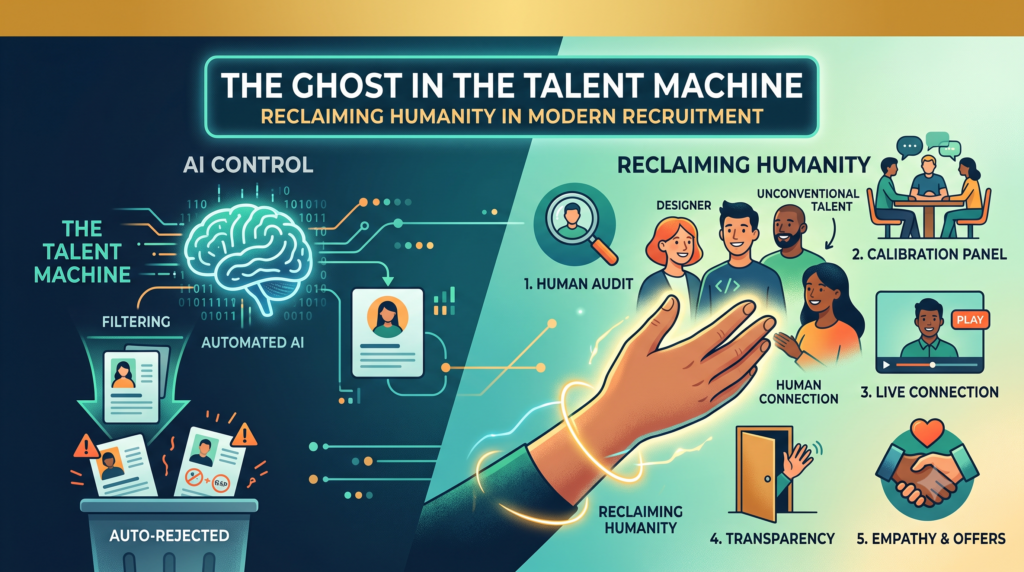
The turning point came when Elena personally audited an auto-rejected candidate: a senior software designer whose resume was dismissed by the algorithm in 0.4 seconds due to a “high-risk employment gap.” In reality, he had taken a sabbatical to build open-source disaster-relief software—a project directly aligned with Aether’s core mission.
“We didn’t build a recruitment pipeline,” Elena told the board. “We built an algorithmic wall. It’s time to put humans back in the loop.”
5 Ways Employers Can Maintain “Human in the Loop” Oversight
Elena restructured Aether’s talent acquisition process around 5 core human-in-the-loop safeguards:
1. Human-Driven “Second-Look” Audits for Edge Cases
- How It Works: Rather than letting the system issue instant, automated rejections based solely on threshold scores, Elena established a human review layer for candidates in non-standard categories (e.g., employment gaps, career pivots, self-taught developers, non-linear education).
- Candidate Impact: Prevents creative talent and non-traditional candidates from being silently purged by rigid keywords.
2. Monthly Algorithmic Calibration Panels
- How It Works: A cross-functional panel comprising recruiters, hiring managers, and DE&I leads conducts monthly sample audits—reviewing 50 accepted candidates and 50 rejected candidates flagged by the AI.
- Candidate Impact: Catches subtle algorithmic bias, false negatives, and keyword drift early, tuning the AI to act as an assistant rather than an unguided gatekeeper.
3. Replacing One-Way Video AI Grading with Live Human Interactions
- How It Works: Elena abolished autonomous one-way video interview grading (which scored facial expressions and voice cadence). In its place, shortlisted candidates were invited to a 15-minute live “Coffee & Connect” conversation with a real recruiter.
- Candidate Impact: Restores empathy, psychological safety, and conversational nuance to the early stages of candidate interaction.
4. Full Transparency & “Request Human Review” Recourse Buttons
- How It Works: Every AI-assisted email carries a clear disclosure. Crucially, all automated assessment and rejection emails include a prominent “Request Human Review” link where candidates can submit brief context if they feel an automated tool misjudged their work.
- Candidate Impact: Gives candidates agency and recourse, building trust and maintaining brand goodwill even during rejections.
5. Compassionate, Human-Led Closings (Offers & Feedback)
- How It Works: While AI generates initial draft templates, all final offer calls and post-interview feedback are delivered directly by human recruiters.
- Candidate Impact: Offers constructive feedback to rejected interviewees and creates a warm, welcoming environment that improves long-term talent retention.
The Result
Within six months of implementing these human safeguards, Aether Dynamics saw candidate Net Promoter Scores (NPS) bounce back by 68%, while quality and diversity of hires reached all-time highs. Technology was restored to its rightful place: an amplifier of human capability, not a replacement for human judgment.