
If you work in talent acquisition, you know the visceral dread that accompanies posting a new job opening. You hit “publish” on LinkedIn or Indeed, and within 48 hours, the deluge begins.
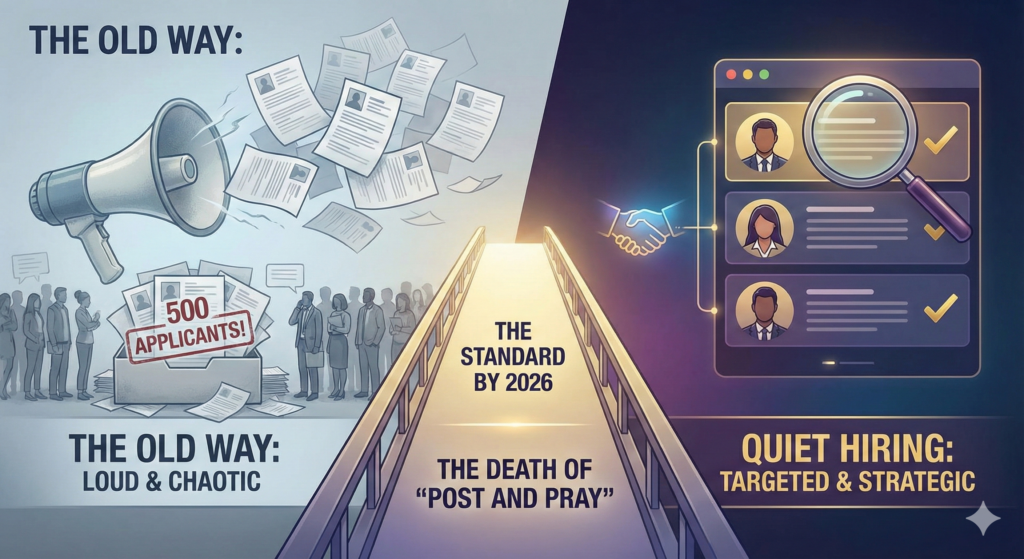
A queue of 500, 800, sometimes 1,000 applicants forms. Thanks to “Easy Apply” buttons and AI-generated cover letters, the barrier to entry for candidates has virtually vanished. The result? A deafening amount of noise and very little signal. Recruiters are drowning in volume, spending valuable hours filtering out unqualified candidates rather than engaging with the right ones.
This model is unsustainable. It is inefficient, impersonal, and increasingly ineffective.
By 2026, I predict this traditional “post and broadcast” method will no longer be the primary way companies fill critical roles. It will be replaced by a new standard: Quiet Hiring.
Defining Quiet Hiring (The Recruitment Version)
Before we go further, let’s clear up the terminology. The media spent much of 2023 defining “quiet hiring” as the practice of quietly assigning new responsibilities to existing employees without explicitly hiring someone new (or giving the employee a raise).
While internal mobility is a piece of the puzzle, that’s not the full definition we are talking about here.
In the context of the future of recruitment, Quiet Hiring means filling organizational gaps through highly curated, targeted sourcing and internal maneuvering, without ever broadcasting the role to the public.
It is the shift from inbound recruitment (waiting for talent to come to you) to pure outbound recruitment (identifying and pursuing the exact talent you need).
Why the Shift is Inevitable by 2026
The transition to Quiet Hiring isn’t a trend; it’s a necessary evolution driven by a broken system. Here is why it will become the standard over the next few years.
1. The Failure of Volume
As mentioned in the introduction, the ease of applying for jobs has broken the traditional funnel. When you receive 1,000 applications, you don’t have a talent pool; you have a data management problem. The time required to vet that volume effectively means top-tier candidates—who are often passive and not applying to job boards—are snatched up by competitors while your team is still reviewing resumes from Day 2.
2. The Rise of AI-Driven Curation
Technology is finally catching up to the need for precision. Until recently, casting a wide net was the only feasible option.
By 2026, AI sourcing tools will be sophisticated enough to map the entire addressable talent market for a specific niche. Instead of posting a job description, a recruiter will input the required skills and cultural markers into an AI platform, which will instantly generate a curated list of the 50 best-fit people in the world for that role, regardless of whether they are currently looking for a job.
The job of the recruiter shifts from “screener” to “relationship builder.”
3. The Need for Stealth and Speed
In a hyper-competitive market, announcing your hiring intentions is akin to showing your hand in poker. Broadcasting that you are desperately hiring five AI engineers tells your competitors exactly where you are investing and where you are currently weak.
Quiet hiring allows companies to execute strategic pivots and build capabilities in stealth mode, securing talent before the market even knows the talent is in demand.
The New Playbook: How Hiring Looks in 2026
If the public job board is dying, what replaces it? The 2026 standard of Quiet Hiring will rely on three pillars:
1. The Internal Market First
The most “quiet” hire is the one already inside the building. Companies will finally get serious about internal mobility marketplaces. Before a manager is allowed to look externally, they must exhaust internal options using AI platforms that match current employees’ skills and career aspirations with open opportunities.
2. The “Always-On” Pipeline
Recruitment will no longer be reactive. You don’t start looking for a Senior Developer when your Senior Developer quits.
Talent acquisition teams will act more like sales teams, maintaining “always-on” relationships with high-value talent pipelines in their CRM. They will nurture relationships with passive candidates over months or years, so when a need arises, they already have a curated shortlist of three people who are warm to the opportunity.
3. The Sniper Approach to Sourcing
Instead of the shotgun approach of job boards, sourcing will be sniper-precise. Hiring managers and recruiters will collaborate to define the exact persona needed. They will then utilize targeted outreach—through professional networks, industry backchannels, and curated communities—to approach only those who fit the profile perfectly.
The End of the Queue
The psychological shift here is significant. We are moving from a mindset of scarcity (we need to get as many applicants as possible to find one good one) to a mindset of abundance and precision (we know who the good ones are; we just need to engage them).
By 2026, seeing a LinkedIn post boasting about “over 500 applicants!” won’t be seen as a sign of a desirable company. It will be seen as a failure of recruitment strategy. The most successful companies will be the ones making the biggest moves without making a sound.