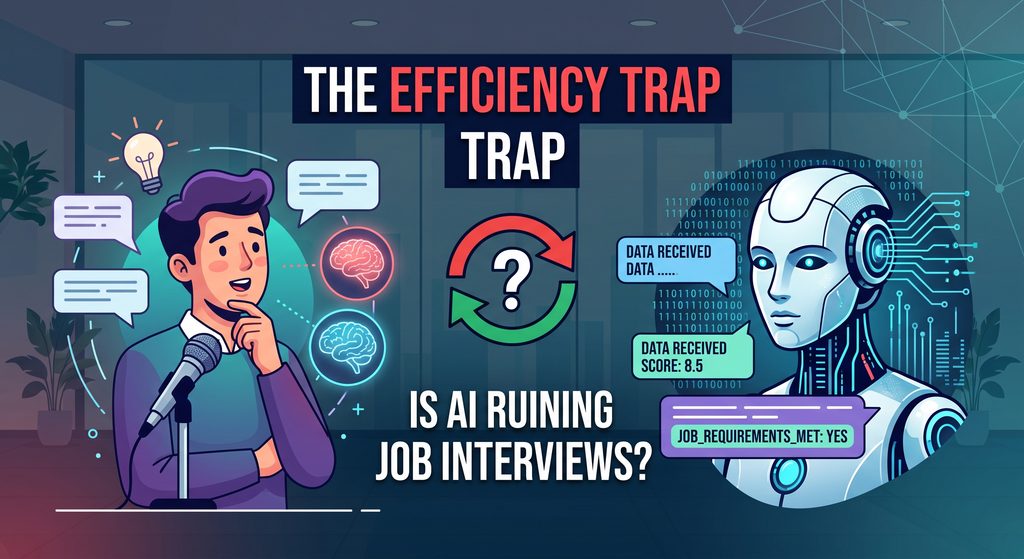
For talent acquisition teams operating in 2026, the hiring math has never looked more lopsided. The number of applicants per open role has doubled since 2022. Meanwhile, multi-year economic turbulence has downsized once-robust recruiting departments into lean operations of one or two screeners trying to manage thousands of resumes.
Enter the automated first-round screening agent. Powered by large language models (LLMs), these tools conduct preliminary phone or video interviews, score responses against the job spec, and hand hiring managers a tidy stack of ranked candidates. Nearly two-thirds of job seekers have already faced an AI interviewer. On paper, it sounds like an operational lifesaver.
In practice, we have to ask a blunt question: Is AI actually ruining job interviews, or just showing us where our early-stage screening was already broken?
The Allure: Triage at Hyperscale
Recruiters didn’t adopt automated interviews on a whim; they reached for them out of triage. When a single requisition attracts hundreds of qualified applicants, human screening at scale becomes virtually impossible without ballooning headcount or relying on clumsy keyword filters.
AI screening tools offer compelling throughput metrics:
- Immediate candidate engagement: Zero scheduling lag; candidates can complete screens asynchronously or via inbound automated calls.
- Standardized initial assessment: Every candidate receives consistent questions tied directly to the job description.
- Synthesis for hiring managers: Scorings, transcription summaries, and alignment metrics arrive without recruiters having to spend 40 hours a week on introductory 20-minute phone screens.
Yet, while AI solves the operational volume problem, it creates a severe qualitative deficit on both ends of the funnel.
Where the Machine Stumbles
Evaluating talent is fundamentally conversational, contextual, and psychological. Today’s LLM-driven screeners fail at this dynamic in three distinct ways:
1. Inability to Probe or Synthesize
LLMs predict token sequences rather than reason through deep professional nuance. When candidates share nuanced, non-linear accomplishments, automated tools frequently fail to ask meaningful follow-ups. If a candidate accidentally utters conversational filler or ambiguous phrasing, the bot often embeds that literal gibberish into its next question, exposing its utter lack of situational comprehension.
2. Penalizing Human Thought
Great answers often require deliberation. Multiple candidates report that natural pauses—taking five seconds to reflect before structuring an answer—trigger awkward tool timeouts, cutting off responses or abruptly forcing the candidate into the next prompt. Instead of rewarding considered responses, the software rewards rapid, robotic compliance.
3. Algorithmic Rigidity and Accessibility Failures
Human recruiters intuitively accommodate speech patterns, eye contact variations, and minor technical hitches. Machine vision and audio models do not. When software instructs a candidate with nystagmus (involuntary eye movement) to “look straight ahead and speak” until the session terminates, the process crosses from inefficient to actively discriminatory and dehumanizing.
The Hidden Cost: Talent Attrition and Candidate Rejection
The most dangerous assumption recruiters can make is that desperate candidates will tolerate any barrier you place in front of them.
Despite a tight, employer-tilted labor market, candidate pushback is accelerating:
- Nearly 40% of job seekers report withdrawing from a recruitment pipeline specifically because it required an AI interview.
- Another 12% state they will drop out proactively if an automated interview is mandated.
When top performers drop out of your pipeline, they don’t do it loudly; they just decline the screening link. The candidates who remain are often those willing to game the bot by stripping nuance out of their answers, talking in explicit yes/no bullet points, and treating the conversation like a search-engine query.
An interview process that selects for bot-gaming over authentic expertise is not screening; it is self-sabotage.
The Recruiter’s Verdict: Ruin or Realignment?
AI isn’t inherently ruining the job interview, but using it as an autonomous gatekeeper is.
When organizations deploy automated agents to handle the initial conversation, they eliminate the critical social contract of hiring: the reassurance, the cultural context, and the candidate’s opportunity to evaluate the employer in return.
To keep AI from destroying candidate experience and brand reputation, talent acquisition teams must rethink where automation belongs:
- Automate administrative friction, not relational discovery. Use AI to draft scorecards, reconcile calendar availability, or surface qualified internal leads. Don’t use it to stand in for human empathy during a high-stakes conversation.
- Treat AI assessments as advisory data points, never binary filters. If an automated screen is used, hiring managers should review the raw recording or candidate notes rather than relying entirely on arbitrary match scores.
- Always provide an opt-out mechanism. Candidates with accommodations, non-traditional communication styles, or simple privacy objections must have an alternate route to human evaluation.
Speed and scale are meaningless if the pipeline only filters for people who speak machine. For recruiters, the competitive advantage over the coming years won’t come from who automates the fastest, but from who knows when to step in and remain human.