
For decades, the recruiter’s life was defined by the grind: the endless scrolling through resumes, the repetitive screening calls, the frantic coordination of interviews. It was, as any veteran in the field will tell you, a high-volume, process-heavy world where critical thinking was often sacrificed for efficiency.
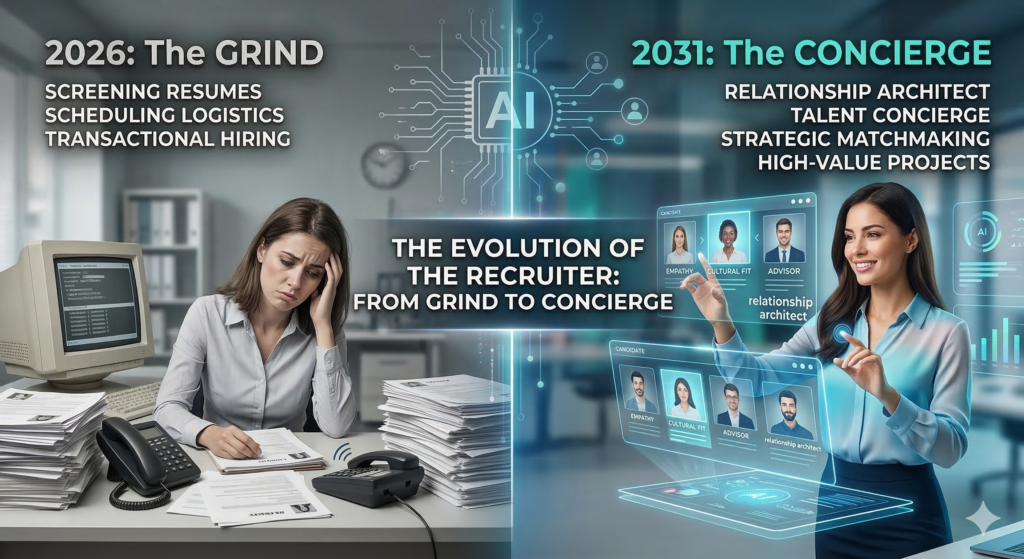
But look up. The horizon is changing.
A technological revolution, driven by the explosive growth of artificial intelligence, is sweeping through the talent landscape. In just five years, the traditional image of the recruiter—tethered to their database, drowning in applications—will be unrecognizable. That role, dominated by administrative “grunt work,” is on life support.
What replaces it is not the replacement of the human, but the amplification of the humane. AI isn’t just automating tasks; it’s liberating recruiters. We are moving from being transactional gatekeepers to strategic relationship architects and talent managing partners.
In five years, the future of recruitment is already here: The age of the Concierge Recruiter.
Part 1: Farewell to the Grind: AI as Your Executive Assistant
To understand the recruiter of 2031, we must first understand what AI is taking off their plate.
The shift is dramatic and already underway. The core administrative tasks that eat up 70% of a recruiter’s time are being automated with startling speed.
- Sourcing and Screening? Done. Instead of a human squinting at keywords in a PDF, AI algorithms will instantly parse thousands of profiles—not just on resume databases, but on forums, GitHub, academic journals, and open-source projects—scoring candidates on skills, experience, and even potential fit, long before a human makes contact.
- The Application Black Hole? Closed. AI-powered chatbots now handle the initial interactions: scheduling, answering FAQs about benefits, and keeping candidates updated on their status. This ends the demoralizing experience of candidates never hearing back, while simultaneously giving thousands of hours back to the recruiting team.
- Logistics? Automated. Co-ordinating the calendars of four busy executives for a panel interview is a complex optimization problem. For AI, it’s a standard task. It handles the back-and-forth, sending reminders, and even providing pre-reading material to both parties, ensuring interviews start on time and are productive.
The recruiter of 2031 is no longer a human filter. They are the strategic beneficiary of a near-perfect operational system.
Part 2: The New Archetypes: How Your Role Evolves
Liberated from the procedural grind, recruiters will see their roles evolve into a set of specialized, high-impact personas. Here are the defining functions of the Recruiter of the Future:
1. The Relationship Architect: The Culture Weaver
In the age of AI, your unique human value proposition is connection. While an algorithm can find a software engineer who knows Python, it cannot (yet) assess if that engineer thrives in a flat, collaborative structure or prefers a high-autonomy environment.
The Relationship Architect’s job is not just to hire, but to match. They spend their time doing the high-touch work that AI cannot replicate:
- In-Depth Cultural Assessment: They move beyond “behavioral questions” and conduct nuanced, empathy-driven conversations to understand a candidate’s values, motivators, and communication style.
- Internal Team Diagnostics: Instead of just working with a hiring manager’s static job description, the Architect works with the entire team the new hire will join. They understand the current dynamics, the missing cognitive diversity, and the personalities that will gel.
- Stakeholder Management: They function as a senior advisor to hiring managers, interpreting AI-driven data to coach managers on interviewing techniques, defining team needs, and managing expectations.
2. The Talent Concierge: The Candidate’s Personal Guide
In the talent war of 2031, the standard “applicant experience” won’t cut it. To attract elite talent, you must treat them like royalty. This is the realm of the Talent Concierge.
The Concierge is tasked with creating a deeply personalized, white-glove candidate journey from first contact through the first 90 days of employment.
- Hyper-Personalized Outreach: They don’t send generic LinkedIn InMails. Working with AI to synthesize a candidate’s public professional history, they craft highly personal outreach that acknowledges the candidate’s specific achievements.
- Candidate Advocacy: The Concierge’s primary client is the candidate. They navigate the interview process for them, providing inside tips on the hiring manager’s style, giving transparent updates, and serving as an empathetic coach.
- Onboarding Success Partner: Their job isn’t done at the offer acceptance. The Concierge proactively creates a personalized onboarding plan, introducing the new hire to key people (both within the team and across the organization), setting up their equipment, and scheduling critical check-ins. They are the single point of contact responsible for the new hire’s integration and long-term success, acting as a true talent managing partner.
3. The Talent Marketer: Building the Brand from Within
Recruitment isn’t just about finding candidates; it’s about making sure candidates are actively looking for you. As the barrier to applying drops, the importance of employer brand equity skyrockets. The Talent Marketer takes on the role of a brand manager for the HR function.
- Internal Content Creation: They don’t just post a link to a job description. They work with teams (e.g., Engineering) to create compelling content: “day-in-the-life” videos, blog posts about complex problems the team is solving, and interviews with current employees.
- Social Amplification: They are digital natives, cultivating a presence on the platforms where niche talent lives (Discord, GitHub, Reddit, niche industry forums) and building a genuine community, not just a job-posting board.
- Candidate Persona Development: Working with data, they build detailed personas of who the company’s ideal candidate is, their motivations, and their fears, tailoring both marketing and the candidate experience to match.
Part 3: What Does Your Tuesday in 2031 Look Like?
So, you’re no longer reviewing resumes. What are you doing? Let’s contrast a typical day:
A Tuesday in 2026:
- 8:30 AM: Scan 200 resumes; reject 175.
- 10:00 AM: 3 back-to-back phone screens (repeat the same questions 3 times).
- 1:00 PM: Fight with the scheduling software and coordinate 4 executive calendars for an interview panel.
- 3:00 PM: “Ghost” 50 applicants because there’s no time to send rejection emails.
- 4:30 PM: Spend an hour sourcing 5 potential candidates on LinkedIn.
A Tuesday in 2031 (As a Concierge/Relationship Architect):
- 8:30 AM: Review the “Potential Matches” report generated overnight by AI. These are pre-screened and scored candidates for the VP of AI role. You spend 30 minutes reading their detailed, synthesized portfolios, not just their resume.
- 9:00 AM: Meet with the Engineering Leadership team. You facilitate a workshop to define the cultural and behavioral competencies the team needs to succeed on Project X, which you’ll add to the hiring profile for the upcoming Director of Engineering search.
- 11:00 AM: Conduct a 90-minute “Cultural Blueprint” interview with a finalist for the Lead Designer role. You don’t ask, “What’s your biggest weakness?” You ask, “Describe the work environment where you were most productive, and the one where you struggled the most.”
- 1:30 PM: Deep Work Session: You analyze data (provided by the Talent Marketer AI) showing that your best hires are coming from a specific university’s research program. You begin crafting a long-term partnership strategy with that university’s career services and faculty, organizing a collaborative hackathon.
- 3:30 PM: Personal Touch: You send a physical, personalized note and a small coffee gift card to three candidates who are starting their final rounds of interviews, providing each with a specific insight into the interviewer’s “passion projects.”
- 4:30 PM: Check-in with a new hire on day 45. They share they are struggling to connect with the product team. You immediately schedule a virtual “coffee break” between the new hire and a key product leader to facilitate the connection.
Part 4: The Mindset Shift: From Gatekeeper to Strategic Partner
This evolution demands a complete paradigm shift for recruiters. To survive the next five years, you cannot just learn new tools; you must fundamentally rethink your value.
The skills you will need in 2031 are:
- Data Fluency: You won’t need to write algorithms, but you must understand them. You need to be able to ask your AI the right questions, interpret the data it produces, and use that data to build your strategic case.
- Business Acumen: The best recruiters will have deep knowledge of their company’s strategy, products, and competitive landscape. You aren’t hiring for “roles”; you are hiring people to solve specific business problems.
- Empathy and EQ: This is your core differentiator. The ability to build trust, to listen between the lines, and to create an emotional connection will be the defining skill that machines cannot replicate.
- Coaching and Advising: You will evolve into a trusted advisor to both candidates and hiring managers, guiding them through complex emotional and strategic decisions.
Conclusion: The Recruiter of the Future is Here
The narrative that AI will kill the recruiting job is not just wrong; it’s unimaginative. It will kill the clerical parts of the recruiting job. The administrative grunt work.
What it liberates is the human-centric core of the profession.
The Concierge Recruiter will be more strategic, more influential, and have a more direct impact on company performance than ever before. They won’t just be the ones that found the hire; they will be the architect of the connection and the steward of the relationship that defines that employee’s success.
The future of recruitment is brighter, more sophisticated, and more human. It is no longer a role of administration. It is a role of inspiration. The only question is: Are you ready to stop being a processor and start being an architect?