
For decades, the path to a robust corporate staff was linear: open headcount leads to requisition, requisition leads to a recruiter (in-house or agency), and the recruiter sifts, selects, and schedules until a candidate is found. The “war for talent” meant recruiters were the vital frontline soldiers, their numbers swelling with corporate growth.
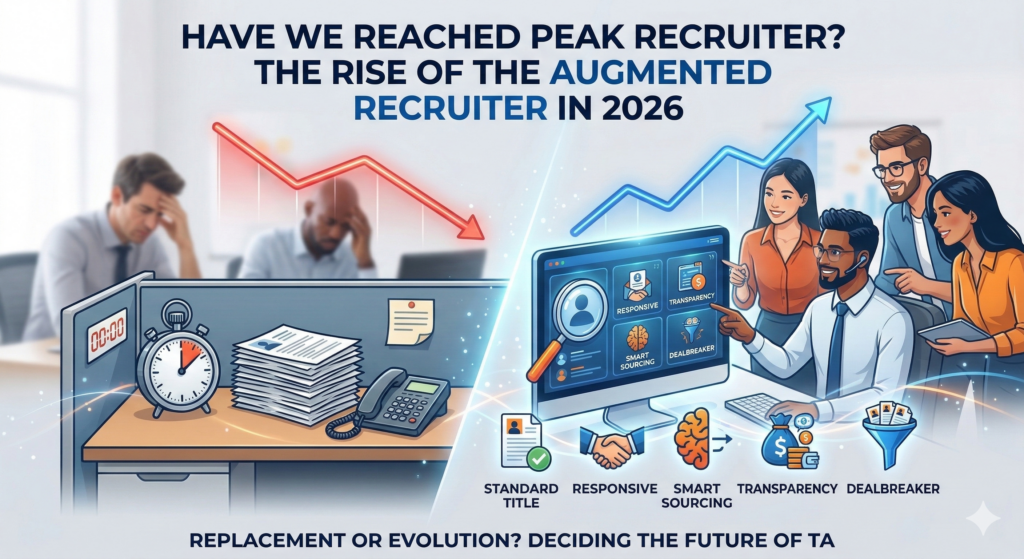
But today, standing amidst the rapid integration of AI and automated hiring tech, a complex question hangs over the talent acquisition industry: have we seen peak recruiter staffing in the United States? Is the profession on the precipice of a significant, permanent contraction as technology takes over?
The argument for contraction—the “Peak Recruiter” theory—is compelling, driven by inescapable technological logic. Yet, a nuanced view suggests that while the recruiting role will transform dramatically, the need for human recruiters is not necessarily going to evaporate.
The Case for Peak Recruiter: The Rise of the Machine-Enabled TA Team
The core argument for “Peak Recruiter” is simple and, for many recruiters, terrifying: technology is replacing the grunt work. If you break down a recruiter’s daily tasks, a massive portion of them are administrative and analytical—tasks AI is now exceptionally good at.
The AI Interview and Screening Revolution
This is the frontline of the technological assault. For years, screening high-volume roles (like retail or customer service) was the most time-consuming and least “strategic” part of a recruiter’s job. Today, AI interview platforms (like HireVue or Modern Hire) use on-demand video interviews where an algorithm “scores” candidates based on verbal cues, language, and keywords.
Simultaneously, “automated screening” has evolved from simple ATS (Applicant Tracking System) keyword filtering to complex AI sourcing that scans not only applications but passive talent profiles across LinkedIn and the wider web, ranking them with superhuman speed. When a machine can screen 10,000 candidates in the time it takes a human to screen five, the sheer headcount needed for high-volume staffing collapses.
The Optimization of “Smart Sourcing”
Our own insights (as highlighted in our list of [5 Essential Tips to Master Indeed](insert link to previous blog post)) point to this trend. Indeed’s latest “Smart Sourcing” features, which leverage AI-powered summaries and automated outreach, allow a single user to find and engage passive talent far more efficiently than the manual cold-calling and emailing of the past. The optimized tools empower a TA professional to do the work of three.
The Transparency and Automation Feedback Loop
When platforms like Indeed force radical salary transparency and automated filtering (the “dealbreaker questions”), they also reduce the amount of time recruiters must spend negotiating, re-explaining roles, and filtering obviously unqualified talent. The efficiency gains cascade.
The Counterargument: Why Peak Recruiter is Still a Long Way Off
If the technological efficiency gains were 1:1 with job loss, the recruiter population would already be a fraction of its former self. Yet, staffing remains relatively high, and top TA talent is still sought after. This leads to the counter-theory: technology won’t replace recruiters; it will evolve the function, shifting it toward value-added human work.
The Human-Centric Premium: Soft Skills and Strategy
The more technology takes over the administrative (sifting and scheduling), the more the core of recruitment becomes uniquely human. This transition is not a “squeeze” but an evolution:
- Candidate Experience as a Brand Differentiator: In a competitive market, candidates choose how they are treated. AI interviews cannot build rapport, show genuine empathy, or articulate a complex company culture. Only a skilled human recruiter can act as a brand ambassador, creating the relationship that secures the acceptance of a top-tier candidate.
- Complex Sourcing and Strategy: While AI is great at the “top of the funnel” (identifying candidates), a human recruiter is vital for complex, niche, or senior-level roles. A machine may struggle to assess a candidate’s “cultural fit,” their leadership adaptability, or their leadership potential across diverse team dynamics—areas that require nuanced human judgment.
- The Advisory Role: As transactional hiring is automated, the recruiter moves up the value chain to become a “Strategic Talent Partner.” They will analyze the data (the hiring insights mentioned on platforms like Indeed), benchmark compensation, and work with leadership to build a proactive talent pipeline aligned with future business needs, not just fill immediate vacancies.
Technology as an Accelerator, Not a Replacer
In many sectors (think healthcare or specialized engineering), the talent shortage is so acute that technology isn’t replacing recruiters; it’s finally giving them the bandwidth to keep up. The AI tools are force-multipliers. Companies will not shrink their TA teams; they will keep them at the current size (or slightly smaller), but the quality and impact of their hires will skyrocket because recruiters are no longer bogged down in the minutiae.
Conclusion: The Future belongs to the “Augmented Recruiter”
The answer to the question “Have we seen peak recruiter staffing?” is likely: “It depends on how you define ‘recruiter.'”
We have likely seen peak staffing for the transactional recruiter—the type who spends 80% of their day screening resumes and 20% scheduling interviews. The demand for that specific, repetitive role will plummet.
However, we are nowhere near peak for the Augmented Recruiter. This is the data-literate, empathetic talent strategist who uses Indeed’s AI as a powerful shovel, not as a replacement for digging. The profession is in the middle of a major transition where skill sets will shift dramatically. Recruiting will move from an administrative “cost center” to a strategic “engine.”
The recruiters who master the new tools will become indispensable, and while the sheer headcount of the TA department might not swell as rapidly as in the past, the value that each recruiter brings to the table will hit its own new peak.