For talent acquisition teams hunting for resilient, high-performing professionals, the newest data from neurodiversity employment network Mentra reveals a massive, untapped market hiding in plain sight.
Mentra’s newly released survey of neurodivergent professionals paints a stark picture of a broken hiring pipeline: the typical neurodivergent job search is lasting up to five times longer than the national average. Yet, the data also uncovers a deeply loyal talent pool possessing the exact skills employers say they need most to thrive alongside AI.

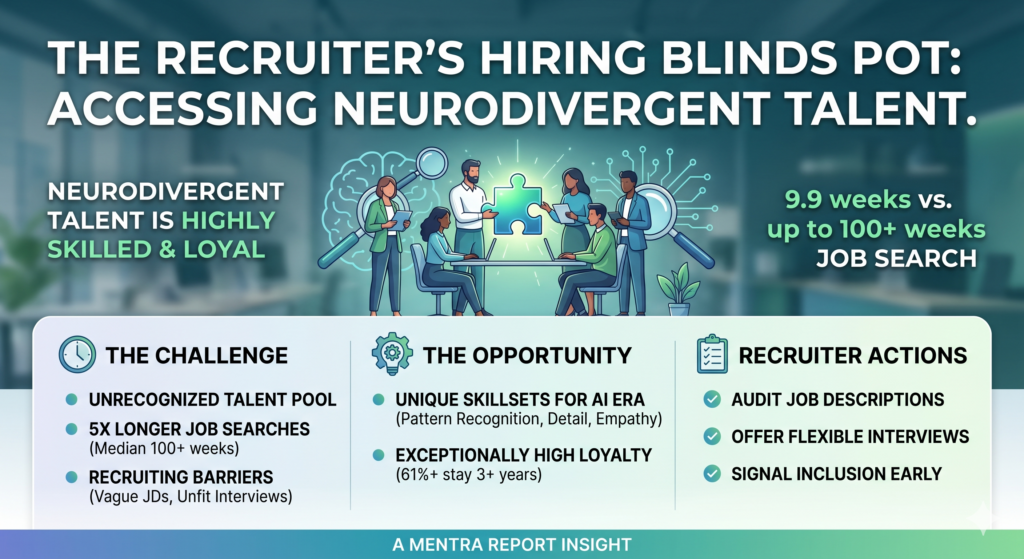
Here is what the data says, and how recruiters can adjust their strategies to capture this overlooked talent.
The Data Breakdown: A Pipeline Problem
While the Bureau of Labor Statistics pegs the national median unemployment duration at roughly 9.9 weeks, neurodivergent professionals are facing a vastly different reality.
- Extended Searches: Nearly 23.4% of neurodivergent job seekers have been looking for work for over two years, with another 15.5% stuck in their second year of a job hunt.
- The Loyalty Premium: Despite a tough path into a role, once hired into the right environment, they stay. 61.9% of neurodivergent employees remain with the same employer for three years or more.
- Invisible Inclusion: For 85% of candidates, fewer than one in four of the jobs they apply to are from employers who publicly commit to neurodivergent inclusion.
The Departure Reality: While 66% of respondents have left a job or turned down an offer due to a poor environment fit, Mentra’s report stresses that this is an issue of structural incompatibility, not employee instability.
What’s Stalling the Process?
According to the survey, the roadblocks aren’t a lack of candidate skill, but rather standard recruiting practices that unintentionally filter them out. Candidates flagged these top barriers:
- Lack of employer understanding (52.1%)
- Inability to find roles matching their skills (49.8%)
- Unclear job descriptions (49.1%)
- Interview formats and disclosure anxiety (40.8%)
The AI Imperative: Skills You Can’t Automate
As generative AI changes technical roles, recruiters are increasingly tasked with finding candidates with strong human-centric and lateral thinking skills. The Mentra survey highlights that the self-identified core strengths of neurodivergent talent align directly with the fastest-growing skills highlighted by the World Economic Forum and McKinsey:
| Top Neurodivergent Strengths Found in Survey | Why They Matter to Modern Employers |
| Pattern recognition & complex problem-solving (73.2%) | Drives efficiency and identifies data anomalies that traditional logic misses. |
| Creative & lateral thinking (61.9%) | Essential for innovation and navigating business pivots. |
| Attention to detail (55.1%) | Acts as a critical quality assurance shield in data-heavy or highly regulated roles. |
| High empathy & people-reading (43.4%) | The exact social-emotional capability AI cannot replicate. |
Actionable Takeaways for Recruiters
“The talent is here, they are highly skilled and remarkably loyal, yet what’s missing is a hiring system built to recognize it,” Mentra CEO and founder Jhillika Kumar noted in the release.
To bridge this gap and access this highly skilled candidate pool, recruiting teams can implement a few practical adjustments:
- Audit Job Descriptions: Swap vague, generic language (“excellent communicator,” “multi-tasking wizard”) for concrete, day-to-day responsibilities and core required technical skills.
- Offer Interview Alternatives: Traditional behavioral interviews often inadvertently test for neurotypical social cues rather than actual job capability. Consider skill-based assessments, providing interview questions 24 hours in advance, or allowing written responses.
- Signal Inclusion Early: Since inclusive employers are largely “invisible” to this talent pool, explicitly state your commitment to neurodiversity accommodations directly on your careers page and job postings.
By building minor flexibilities into the top of your hiring funnel, your team can secure loyal, uniquely skilled professionals that your competitors are entirely overlooking.