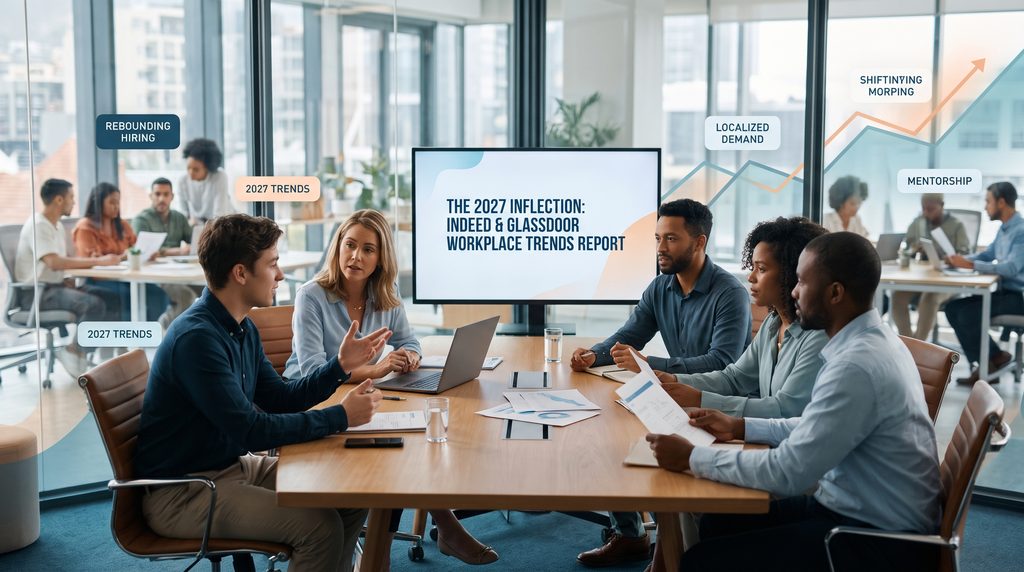
After three years of a “low-hire, low-fire” freeze, the labor market is finally showing signs of thawing. According to Indeed & Glassdoor’s 2027 U.S. Hiring and Worklife Trends Report, 2027 is shaping up to be an inflection year. While macro indicators still look sluggish, pent-up worker frustration and shifting local demand are setting the stage for a sudden surge in both hiring competition and employee turnover.
For talent acquisition (TA) leaders, the playbook that worked during the stagnant market of 2024–2026 won’t cut it in 2027. Here is a breakdown of the six core trends defining the year ahead—and how TA teams can get out in front of them.
1. A Rebounding Market Could Trigger a “Turnover Wave”
For the past few years, dissatisfied workers stayed put because opportunities were scarce. That dam is starting to crack. As hiring demand loosens—with early rebounds already appearing in AI-exposed fields like software development, engineering, and banking—employees who felt trapped in 2026 will be the first to jump ship.
- The TA Takeaway: Retention is recruiting in 2027. Partner with HR business partners now to identify flight risks and audit internal mobility pathways before competitors start poaching your stagnant talent.
2. Talent Competition Will Heat Up Locally, Not Nationally
Forget one-size-fits-all national recruiting strategies. While the share of U.S. metros with year-over-year job posting growth jumped from 10% at the start of 2026 to nearly 50% by autumn, recovery is deeply uneven. Sunbelt hubs like Dallas, Austin, and Houston sit 12% to 15% above pre-pandemic posting baselines, while tech-heavy markets like Seattle and San Francisco remain roughly 30% below.
- The TA Takeaway: Calibrate your sourcing budgets, time-to-fill expectations, and compensation benchmarks by specific metro and role rather than relying on national averages.
3. Gen Z Is Moving Into Management—and They’re Restless
Gen Z now makes up nearly a quarter (24%) of the workforce and is projected to outnumber Baby Boomers in management roles in 2027. While they are surprisingly optimistic about the job market and rate their employers higher than older cohorts do, nearly a third of employed Gen Zers are actively job hunting. Why? A massive mentorship gap: 58% want a mentor, yet only 25% actually have one.
- The TA Takeaway: Highlight structured mentorship, leadership development, and workplace culture in your employer value proposition (EVP). Contrary to stereotypes, many Gen Z workers actually prefer hybrid or onsite environments where they can build those in-person connections.
4. There Is No “AI Jobpocalypse,” Just Growing “AI-nxiety”
AI adoption across job postings continues to climb steadily—especially outside traditional tech—creating broad but shallow workplace transformation rather than mass job elimination. However, worker sentiment is souring: positive mentions of AI in Glassdoor reviews have plummeted from 81% in 2019 to just 45%. Employees aren’t necessarily afraid of losing their jobs to AI, but they are frustrated by poorly implemented tools and a lack of training.
- The TA Takeaway: When hiring for AI-adjacent roles, be transparent about how AI is actually used on the team, and emphasize your organization’s commitment to upskilling rather than expecting candidates to figure it out on their own.
5. The Bottom Rung of the Career Ladder Is Disappearing
Since January 2025, senior-level job postings have climbed 19%, while entry-level postings have shrunk. Consequently, more than half of 2025 college graduates found themselves underemployed a year out of school. By over-indexing on senior talent and cutting early-career pipelines, companies risk starving their future leadership bench.
- The TA Takeaway: Audit your job descriptions. Strip out inflated experience requirements and pedigree filters. Rebuilding entry-level pipelines—and hiring for transferable skills from adjacent industries—will give you access to untapped talent pools your competitors are ignoring.
6. Wage Growth Trails Inflation, Pushing Benefits Into the Spotlight
Advertised wage growth has cooled to 2.5% annually while consumer prices have risen 3.7%. Meanwhile, employer health insurance costs have surged 25% over the past four years. As a result, worker satisfaction with pay and benefits has hit its lowest point since 2017.
- The TA Takeaway: If you can’t win every bidding war on base salary alone, sell the total package. Candidates are scrutinizing healthcare premiums, PTO, and schedule flexibility more closely than ever. Make sure your recruiters—and your job postings—explicitly advertise the full value of the benefits you already offer.
Your 2027 TA Action Checklist
- Audit job descriptions to separate “day-one must-haves” from trainable skills, reopening doors for early-career and career-switcher talent.
- Showcase total rewards upfront in job ads—highlighting health coverage, flexibility, and growth paths costs nothing and differentiates your offers.
- Localize your hiring strategy to account for regional surges in competition before time-to-hire spikes.
- Market your mentorship and AI training programs during interviews to attract—and keep—the next wave of Gen Z leaders.