
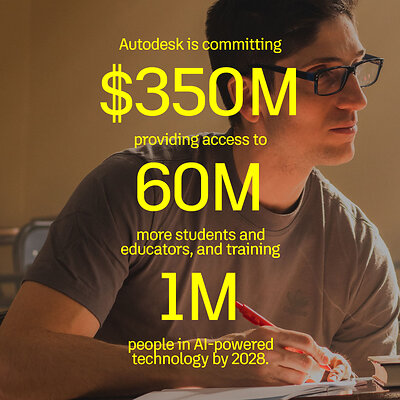
SAN FRANCISCO — In response to a rapidly evolving labor market and a widening skills gap, design software giant Autodesk announced a major three-year, $350 million initiative aimed at preparing students and the workforce for artificial intelligence-driven roles in the physical-world industries.
The commitment, announced alongside the company’s second annual AI Jobs Report, aims to bridge a critical disconnect: while today’s students are highly comfortable with everyday generative AI, few feel equipped to handle the specialized AI tools transforming their future workplaces.
The investment targets the “Design and Make” sectors—which include architecture, engineering, construction, manufacturing, and media creation. These industries currently employ nearly 300 million people globally and are projected to reach a market value of $30 trillion by 2027.
A Three-Pronged Strategy for the Future Workforce
Autodesk’s $350 million pledge outlines three concrete objectives to be achieved by the end of 2028:
- Expanding Software Access: The company will extend free access to its professional-grade software suite to an additional 60 million students and educators globally. This builds upon Autodesk’s existing footprint, which has already supplied tools to 150 million users across 160,000 institutions.
- Mass Upskilling and AI Training: Autodesk plans to train nearly one million individuals—including students, educators, and trade union apprentices—in AI-powered design workflows. The curriculum will expand beyond pure digital design to integrate modern, tech-driven jobsite practices like Building Information Modeling (BIM) and advanced mechanical work.
- Industry-Recognized Certification: To meet a shifting hiring landscape, Autodesk plans to help more than 200,000 people secure professional credentials. While a staggering 92% of employers say they prioritize certifications in their workforce strategy, Autodesk’s data shows only 27% of students are currently pursuing them.
“AI is raising the floor for everyone, but it is human ingenuity that will vault the ceiling,” said Dara Treseder, Chief Marketing Officer at Autodesk. “The next generation already has the curiosity, creativity, and ambition to solve real problems. What too many young people still lack are the professional tools, training, and experiences that help turn that potential into a career.”
The “Readiness Gap” and an Unexpected Shift
Autodesk’s investment is a direct response to a stark “readiness gap” highlighted in its latest research, conducted in partnership with analytics firm GlobalData.
The study found that while 82% of students aged 14 to 23 feel confident using mainstream AI tools like ChatGPT and Claude, only 36% feel capable of using the specific AI applications required in their chosen career paths. Compounding the issue, 80% of students reported they are currently self-teaching these job skills online, rather than learning them through formal internships or classwork.
Meanwhile, corporate demand is moving at an aggressive pace. The report notes that AI-related job listings across construction, engineering, and manufacturing have surged by nearly 250% over the last two years. Notably, the fastest-growing hiring demands are centered on human-centric skills like design, communication, and leadership, which employers are prioritizing over pure programming and coding.
The report also uncovered a surprising cultural shift: rather than keeping the younger generation glued to screens, the rise of AI appears to be steering them toward physical work. More than 66% of surveyed students expressed a desire for careers where they can make things or work with their hands—a six-point increase from 2024. When weighing digital-only career paths against physical-world jobs, students favored the physical world by a margin of more than two to one.