
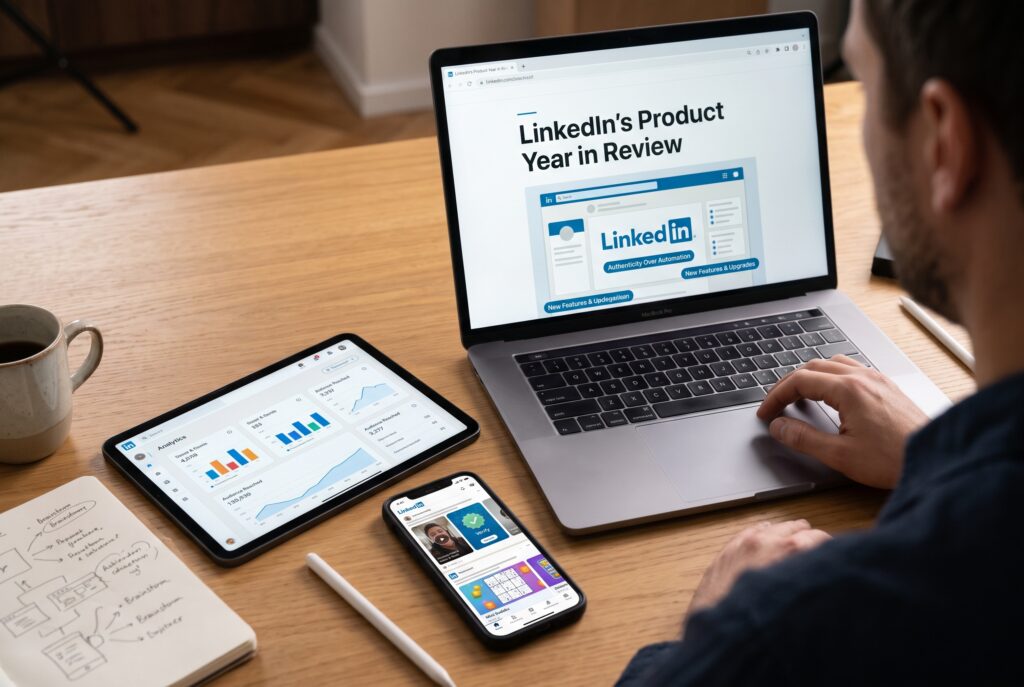
If there is a single theme running across LinkedIn’s product roadmaps this year, it’s authenticity over automation.
While prior years were defined by rushing AI into every text box, this year brought a much-needed course correction. The platform focused on curbing low-effort “AI slop,” rewarding verified human expertise, upgrading how candidates discover roles, and leaning into modern engagement formats like short-form video and daily puzzles.
Here is a full breakdown of the major member and product updates LinkedIn rolled out across the board this year.
1. Combatting AI Slop & Championing “Trusted Voices”
Generative AI made content creation easy—perhaps too easy. In response to member feedback around repetitive, robotic feed posts, LinkedIn fundamentally updated its content and ranking philosophy:
- Retiring “Post Enhancement” for “Post Proofreader”: LinkedIn officially retired its one-click AI rewriting feature (“Enhance your post”). It was replaced with Post Proofreader, an AI editor designed to polish member drafts for clarity and grammar without overwriting personal voice and style.
- Algorithm & Feed Reset: The feed algorithm was overhauled to deprioritize engagement bait and generic, auto-generated essays. In their place, LinkedIn began heavily indexing for deep niche knowledge, firsthand career advice, and substantive discussions.
- AI Labeling & Transparency: Content that contains AI-generated media now carries explicit labeling so members can distinguish between synthetic content and real-world media.
2. Verified Identity & Trust Infrastructure
In an era dominated by synthetic profiles, fraud, and impersonation, trust became LinkedIn’s flagship currency:
- Expanded Verification & Colleague Vouching: Member verification badges expanded globally, alongside new “colleague vouching” mechanics to verify past work history and authentic employment.
- Verified Filter for Comments: Creators and members can now filter and prioritize replies from verified users, drastically cutting down on bot spam.
- Premium Company Page Checkmarks: Small-to-midsize businesses and verified brand pages can display verified tick badges, safeguarding against spoofed corporate profiles.
3. Smarter, Conversational Job Seeking & Career Tools
Job hunting moved away from rigid keyword filters toward intuitive, natural-language exploration:
- Conversational AI Job Search: Job seekers can now search by describing what they want in plain sentences (e.g., “Find mid-level hybrid product management roles at B-Corps with tuition reimbursement”). This was expanded internationally into Spanish, French, German, and Portuguese.
- All-in-One Job Tracker: A centralized dashboard allowing applicants to organize their pipeline, track interview stages, and note updates directly inside LinkedIn.
- AI-Powered Custom Mock Interviews: Job seekers gained access to interactive interview prep that analyzes role descriptions and simulates realistic practice questions with actionable feedback.
- Application Status Badges: Recruiters can now indicate an “Actively reviewing applications” status, helping candidates gauge response times and pipeline health.
4. Vertical Video & Rich Media Maturation
Video became a primary pillar of LinkedIn’s daily user experience:
- Dedicated Full-Screen Video Feed: LinkedIn solidified its swipeable vertical video feed, giving creators and professionals a native space to share quick workplace tips, case studies, and career stories.
- Direct Partner Integrations: Creative workflows improved with direct publishing integrations (such as one-tap exports from mobile video editors like CapCut).
- Player Controls & Auto-Captions: Added native playback speed toggles (1.25x, 1.5x) and automatic high-contrast captioning for accessible, sound-off viewing on mobile.
5. Deeper Analytics for Creators & Publishers
LinkedIn overhauled post analytics to give writers, marketers, and founders clearer signals about actual impact:
- Saves & Sends Metrics: Creators can now see exact counts for Saves (bookmarks) and Sends (direct messages on LinkedIn). These metrics have quickly become the gold standard for measuring genuine content utility over superficial “likes.”
- In-Network vs. Out-of-Network Reach: Dashboards now break down what percentage of viewers come from direct 1st-degree connections versus the broader LinkedIn public, helping creators identify breakout topics.
- Newsletters for All: Newsletter publishing tools were unlocked platform-wide, allowing all members to build recurring subscriber bases.
6. Daily Games & Community Micro-Moments
To keep daily engagement high and bring back casual, workplace-friendly downtime, LinkedIn expanded its in-app games hub:
- New Puzzles: Additions like Patches, Mini Sudoku, and Wend joined existing favorites (Queens, Pinpoint, and Crossclimb).
- Company & Network Leaderboards: Members can now compete daily against colleagues, alumni networks, and industry peers—turning logic puzzles into a low-stakes networking icebreaker.
7. Profile Upgrades & Entrepreneurial Tools
Profiles shifted from static resumes to living professional storefronts:
- Digital Business Card: A scannable mobile display feature that lets members instantly share their profile via QR and tailored digital cards at conferences and meetups.
- “Get Advice” & Booking Direct from Profiles: Capitalizing on the surge of independent consultants and fractional executives, LinkedIn introduced direct booking integrations, enabling professionals to schedule meetings and paid consultations right from their header.
- Connected Apps & Verified Skills: Instead of unverified peer endorsements, members can link third-party apps and learning credentials to prove hands-on technical proficiency.
The Takeaway
LinkedIn used this year to mature beyond the wild-west phase of GenAI. By substituting auto-generated noise with verified credentials, high-signal conversational search, and utility metrics like Saves and Shares, the platform reinforced its core promise: a network built on real people doing real work.