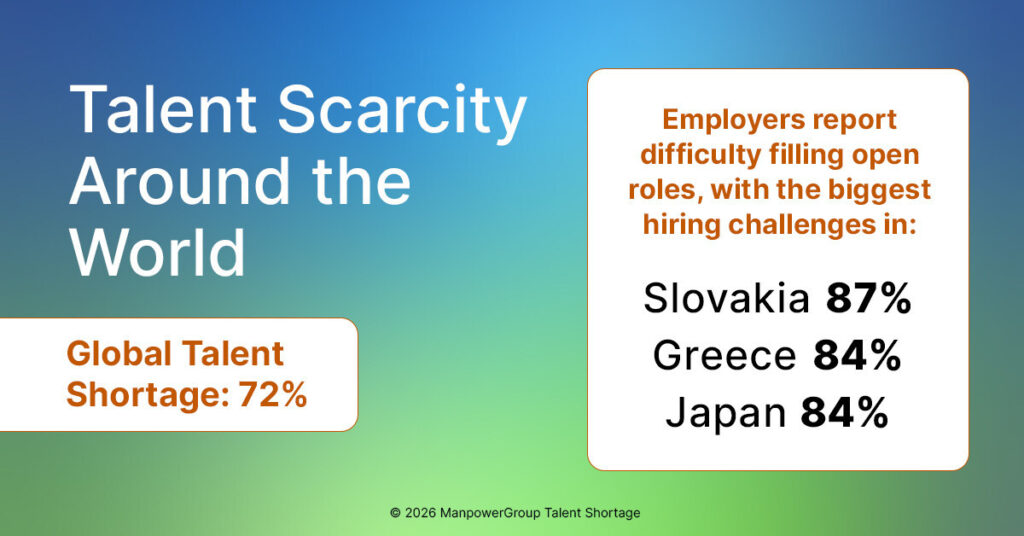
For the first time, Artificial Intelligence (AI) skills have surpassed all others to become the most difficult for employers to find globally, overtaking traditional engineering and IT capabilities. This historic shift highlights a new era in the persistent global talent crisis, with 72% of employers reporting hiring difficulty—down modestly from 74% last year—according to the 2026 Talent Shortage Survey released today by ManpowerGroup.

“The rise of AI skills to the top of the shortage list reflects how quickly the talent landscape is evolving,” said Jonas Prising, ManpowerGroup Chair & CEO. “Companies are responding with upskilling and more flexible workforce models, recognizing they will need to hire for potential; while building AI literacy across their workforce so people can apply new technology with judgment and confidence. AI is not replacing jobs, it is reshaping work, and companies that connect productivity gains with opportunity and career growth will be best positioned to compete in a talent-scarce world.”
The research, spanning more than 39,000 employers in 41 countries, reveals that modest relief in overall hiring has been offset by fierce competition for AI capabilities.
2026 TALENT SHORTAGE SURVEY KEY FINDINGS
- AI Creates a New Hierarchy of Technical Demand
AI Model & Application Development (20%) and AI Literacy (19%) now lead the global ranking of hard-to-find skills, followed by Engineering (19%), Sales & Marketing (18%), and Manufacturing & Production (17%). Together, these AI capabilities displace traditional IT & Data skills, which fell to seventh place (17%), signaling a rapid realignment of strategic talent investment toward AI-driven capabilities. - The Human Edge Becomes More Valuable
Even amid the surge in demand for AI, core human skills remain in-demand. Communication, Collaboration & Teamwork are the most sought-after attributes at 39%, followed by Professionalism & Work Ethic (36%) and Adaptability & Willingness to Learn (34%), reinforcing the enduring value of interpersonal skills. - Geography Defines the Scarcity Experience
The pressure to find talent is universal, yet its intensity varies dramatically by location. Employers in Germany (83%), France (74%), and the U.K. (73%) face significant shortages, while the U.S. (69%) tracks slightly below the global average. China (48%) stands out as the least constrained major market, revealing a fragmented global landscape where local conditions dictate competitive strategy. - Scarcity Is a Cross-Industry Phenomenon
While the Information industry faces the highest shortage (75%), critical service sectors like Hospitality (74%) and Public Sector, Health & Social Services (74%) report nearly identical levels of strain. This widespread challenge extends across Professional, Scientific, and Technical Services (73%), Manufacturing (72%), and Finance and Insurance (71%), indicating a broad-based constraint on economic growth and service delivery. - Employer Strategy: Invest, Adapt, and Compete
Faced with structural scarcity, 91% of employers are deploying a mix of strategies. The primary focus is on internal development and flexibility: Upskilling/Reskilling (27%) leads, followed by offering more Schedule Flexibility (20%) and Location Flexibility (18%). To compete externally, Increasing Wages (19%) and Targeting New Talent Pools (18%) are critical levers. - Scale Exacerbates the Challenge
Organizational size significantly impacts hiring success. The largest companies—those with 1,000-4,999 employees—report the highest shortage rate (75%). This is 11 points higher than the smallest firms (under 10 employees at 64%).
For more information about ManpowerGroup’s 2026 Talent Shortage Survey, visit: https://www.manpowergroup.com/en/insights/2026-global-talent-shortage