
The world of work has undergone a seismic shift in recent years, and at the epicenter of this transformation lies the widespread adoption of remote work. A comprehensive study conducted by Flatworld Solutions, spanning from 2022 to early 2025, provides invaluable insights into this evolving landscape within the United States.
By meticulously analyzing data from the Bureau of Labor Statistics (BLS) and Google Trends, the report illuminates the remarkable growth, geographical nuances, demographic shifts, and emerging challenges associated with the telework phenomenon. While the allure of flexibility has resonated deeply with the workforce, the study also highlights a growing tension as executive concerns regarding collaboration, culture, and control fuel a push for return-to-office mandates.
Furthermore, the rise of Global Capability Centers (GCCs) and a disturbing surge in online job scams targeting remote workers add layers of complexity to this unfolding narrative. Let’s delve deeper into the key findings and themes that are reshaping the future of how and where we work.

1. The Unstoppable Ascent of Remote Work:
The Flatworld Solutions study unequivocally confirms the significant and sustained growth of remote work adoption across the United States. The numbers speak for themselves: an impressive climb from 19.9% in October 2022 to 23.6% in January 2025, representing an 18.6% overall increase. This isn’t just a fleeting trend; it signifies a fundamental change in how work is perceived and executed.
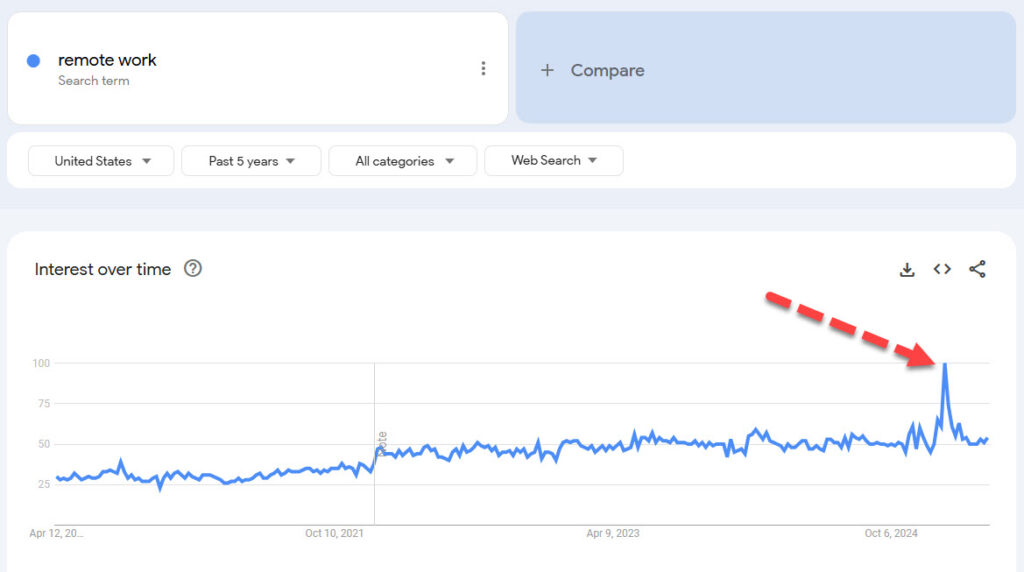
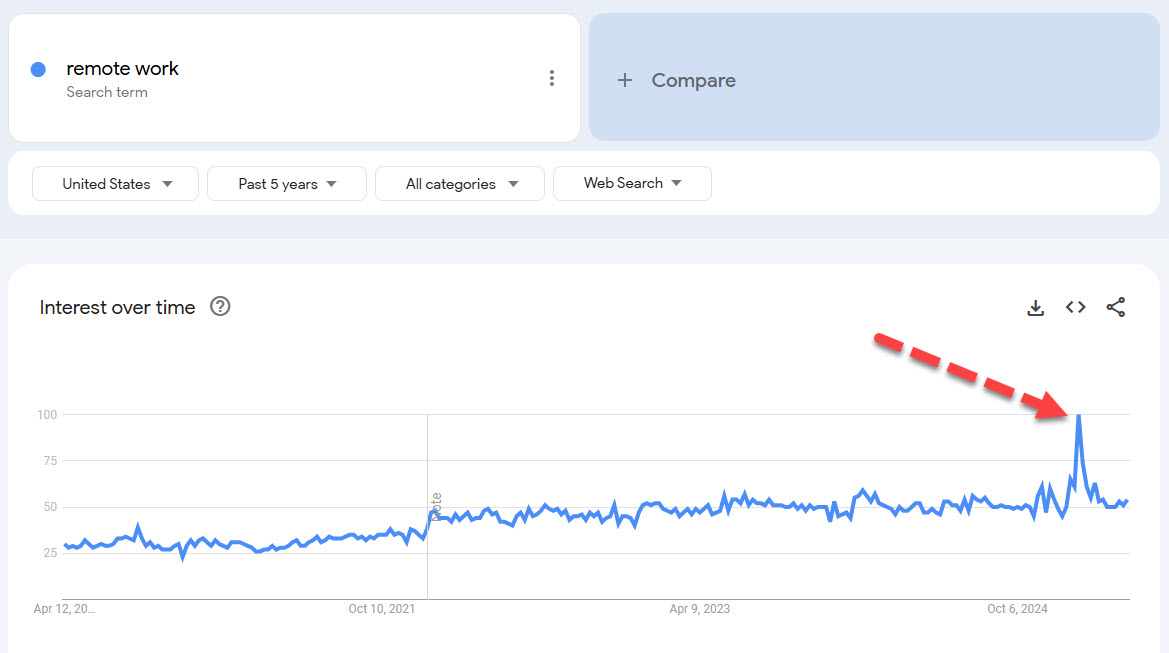
Further underscoring this shift is the dramatic surge in public interest. Google search interest for “remote work” has skyrocketed by 134% between 2020 (index 29) and 2025 (index 67.9), with the most significant leap occurring in the recent year. This explosion in online queries reflects a growing curiosity, adoption, and integration of remote work into the fabric of American working life.
As Israel Paul, Head of Human Resources at Flatworld Solutions, aptly stated, “the exponential jump in remote work adoption reflects more than just a temporary shift—it signals a fundamental redefinition of workplace digital transformation.” This quote encapsulates the profound and lasting impact of remote work on organizational structures and technological infrastructures.
2. A Nation Divided: Regional Disparities in Telework Adoption:
While the overall trend points towards increased remote work, the Flatworld Solutions study reveals significant regional variations across the United States. As of 2023 data, states like Colorado (31.7%), Massachusetts (29.4%), Washington (28.5%), and Maryland (27.6%) are leading the charge in telework adoption. These states, often characterized by a strong presence of technology and knowledge-based industries, have seemingly embraced remote work more readily.
Conversely, states such as Mississippi (4.7%), Alabama (7.7%), and Arkansas (9.0%) exhibit the lowest rates of telework adoption. This disparity likely reflects a combination of factors, including the prevalence of industries that necessitate on-site presence, infrastructure limitations, and potentially differing cultural norms around work arrangements.
Notably, the District of Columbia stands out with the highest adoption rate at a staggering 56.5%, likely due to its concentration of government and professional services. At the other end of the spectrum, Mississippi’s 4.7% underscores the stark contrast in remote work penetration across the nation. Understanding these regional disparities is crucial for businesses formulating location-based talent strategies and for policymakers addressing workforce trends.
3. The Evolving Face of the Remote Worker:
The Flatworld Solutions study also sheds light on the changing demographics of the remote workforce. Interestingly, workers aged 35-44 have the highest average telework rate at 28.1%. This demographic, often balancing established careers with family responsibilities, likely finds the flexibility of remote work particularly appealing.
Perhaps one of the most surprising findings is the significant growth in telework adoption among men aged 65+, who experienced a remarkable 54.6% increase (from 17.4% in 2022 to 26.9%). This suggests a growing comfort and adoption of remote work technologies among a demographic traditionally less associated with remote roles, potentially driven by factors like increased digital literacy and the desire for continued engagement in the workforce on their own terms.
Conversely, workers aged 16-19 are the least likely to telework, with an adoption rate of only 2.7%. This is understandable given their typical entry-level positions often require on-site training, collaboration, and supervision.
Israel Paul emphasizes the importance of these demographic shifts, stating, “Distinct demographic and occupational trends in telework are reshaping how organizations plan their talent strategies. For instance, significant growth among older workers underscores the critical role of adaptable work environments powered by data-driven insights.” This highlights the need for organizations to tailor their remote work policies and technologies to cater to the diverse needs and preferences of their evolving workforce.
4. Industry and Occupation: Where Remote Work Thrives:
The study further dissects remote work adoption across various occupations and industries, revealing predictable yet insightful patterns. Unsurprisingly, computer and mathematical occupations lead the way with a high telework adoption rate of 69.9%, followed closely by business and financial operations (59.2%) and legal occupations (52.6%). These roles often involve tasks that can be effectively performed remotely with the right technology infrastructure.
In terms of industries, professional and technical services stand out with a telework adoption rate of 56.3% (reaching 59.3% in recent periods), closely trailed by finance and insurance at 61.7%. These sectors, characterized by information-intensive work and a reliance on digital tools, have naturally gravitated towards remote work models.
These findings underscore the fact that the suitability and adoption of remote work are heavily influenced by the nature of the work itself. Industries and occupations that are more digitally oriented and require less physical presence are more likely to embrace remote arrangements.
5. The Rise of Global Capability Centers (GCCs): A Strategic Response:
The Flatworld Solutions study highlights a significant trend: the increasing prevalence of Global Capability Centers (GCCs), encompassing both virtual and offshore models. As companies navigate the remote work landscape, they are increasingly looking to tap into global talent pools, and GCCs provide a strategic framework for achieving this.
The Google Trends data cited in the report vividly illustrates this surge in interest, with searches for “capability centers” in the U.S. rising from near zero in early 2020 to a peak of 100 in January 2025. This dramatic increase signifies a growing recognition and adoption of GCCs as a key component of global talent strategies in the remote work era.
Israel Paul notes that “This transformation represents not just a response to immediate remote work needs but a strategic shift in how companies structure their IT and software service delivery for long-term resilience and competitive advantage.” The rise of GCCs reflects a proactive adaptation by organizations to leverage the opportunities presented by remote work to access diverse skills and potentially optimize costs.
6. The Brewing Conflict: Return-to-Office Mandates and Employee Resistance:
Despite the widespread embrace of remote work and its evident benefits for many, the Flatworld Solutions study highlights a growing tension point: return-to-office (RTO) mandates. Several major corporations, including Amazon, AT&T, and JPMorgan, are pushing for a full return to traditional office settings, citing concerns about weakened collaboration, eroded company culture, and perceived difficulties in maintaining control over remote teams.
However, these mandates are not being met without resistance. The study reveals that 42% of companies mandating office returns are experiencing higher-than-anticipated attrition, and 29% are struggling with recruitment. This pushback underscores the value employees place on the flexibility and autonomy afforded by remote work.
Looking ahead, approximately 23% of companies plan to implement an RTO policy by the end of 2025, while 7% are delaying such decisions until 2026 or later. This indicates an ongoing debate and a lack of universal consensus on the optimal work model. The conflict between executive concerns and employee preferences will likely continue to shape the future of work, with companies needing to carefully weigh the potential benefits and drawbacks of different approaches.
7. The Dark Side of Remote Work: The Surge in Online Job Scams:
The rapid growth of remote work has unfortunately been accompanied by a concerning trend: a significant increase in online job scams. The Flatworld Solutions study highlights the alarming rise in reported losses, more than tripling since 2020, with over $220 million lost in the first half of 2024 alone.
A particularly insidious form of these scams involves gamified task scams that cleverly mimic legitimate employment opportunities, luring unsuspecting job seekers into fraudulent schemes. This dark side of the remote work revolution underscores the need for increased vigilance and awareness among both job seekers and employers.
Israel Paul emphasizes the critical need to address this issue, stating, “With the alarming rise in job scams targeting remote workers and the pushback we’re seeing with office returns, it’s clear that protecting our workforce while maintaining productivity is a delicate balance. Success in this new era isn’t just about having the right technology—it’s about understanding and supporting the people using it.” This highlights the importance of robust security measures, employee education, and ethical recruitment practices in the evolving world of remote work.
Conclusion: Navigating the Complex Landscape of the Future of Work:
The Flatworld Solutions study provides a comprehensive and insightful snapshot of the remote work landscape in the United States between 2022 and early 2025. It paints a picture of a workforce that has largely embraced the flexibility and autonomy offered by remote arrangements, leading to significant growth and acceptance across various demographics and industries. However, this transformation is not without its complexities. Executive concerns regarding collaboration and culture are driving a push for return-to-office mandates, creating a potential point of friction with employee preferences. Furthermore, the emergence of GCCs signifies a strategic adaptation by companies to leverage global talent in this new era, while the alarming rise in online job scams serves as a stark reminder of the vulnerabilities that can accompany remote work.
Navigating this evolving landscape requires a delicate balancing act. Organizations must carefully consider the benefits and drawbacks of different work models, taking into account employee preferences, the nature of their work, and the need to foster collaboration and maintain a strong organizational culture. Simultaneously, robust measures must be implemented to protect remote workers from the growing threat of online job scams. The future of work will likely involve a hybrid approach for many organizations, requiring a thoughtful and data-driven strategy that prioritizes both productivity and the well-being of the workforce in this increasingly digital and distributed world. The insights from Flatworld Solutions’ study serve as a crucial guidepost in this ongoing evolution.
The post How Remote Work is Evolving in the U.S. first appeared on RemoteFetch Blog.